

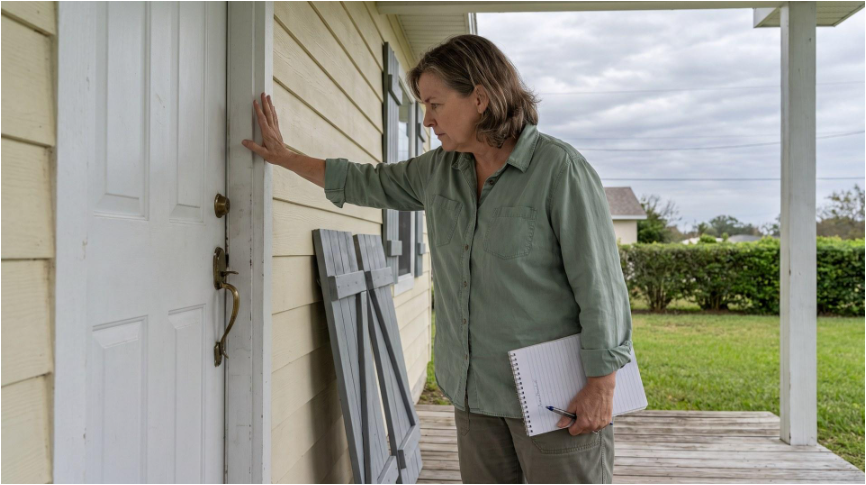
Every coastal household has a version of the same list. Fuel for the generator, water, batteries, shutters, gutters cleared, loose furniture brought in, prescriptions topped up. It is a good list, refined over many seasons, and it almost never contains a single line about the doors.
That is an odd omission, because the exterior doors are the part of the envelope most likely to be tested and the part most likely to be needed in a hurry. They have to seal against driven rain, stay shut under pressure differential, and then open reliably in the dark with the power out. Very little else on the list is asked to do three jobs that different.
What Weather Does to a Door Before the Weather Arrives
Doors in a humid coastal climate live in slow motion all year. The slab absorbs moisture and swells slightly through the wet months, then gives it back. Hinge screws, worked by that cycle and by salt air, loosen a fraction at a time. The result is a door that sits a millimetre or two lower than it did, so the bolt no longer meets the centre of the strike, and the weatherstrip no longer compresses evenly along its length.
Neither symptom is dramatic. Both matter under storm conditions, when the weatherstrip is what stops water tracking across the threshold and the bolt is what stops the slab flexing in its frame.
A Fifteen-Minute Inspection Anyone Can Do
Start with the reveal. Close each exterior door and look at the gap between slab and frame from top to bottom. It should be even. A gap that narrows at the top on the latch side means the door has dropped and the hinges want attention.
Next, the bolt. Throw the deadbolt with the door closed. If it needs a shoulder, a lift, or more than light finger pressure, the strike is out of alignment. Then the seal: run a hand along the weatherstrip and look for flattened, cracked or compressed sections, particularly at the corners. Finally, the hardware itself: tighten every visible screw on the hinges, the strike plate and the handle set, and note any that will not bite.
Anything that fails those four checks is a small repair now and an urgent one later. Homeowners who would rather not diagnose it themselves can have a locksmith in Palm Coast, FL walk the openings in a single visit, which is considerably cheaper than dealing with a swollen, jammed door once the rain has already arrived.
The Part People Only Think About Afterwards
Two further items belong on the list and rarely make it. The first is keys. Storm season is when houses fill with people: family staying over, a neighbour checking in, a contractor coming through afterwards. It is the worst possible moment to discover there is exactly one working key to the back door. Cutting spares in advance takes minutes, and anyone managing a second property will recognise most of this from the standard Florida rental security checklist.
The second is electronic hardware. Battery-powered locks should have fresh cells before the season rather than during it, and every household member should know where the mechanical override key lives. Service firms such as Lockey Locksmith see a predictable spike in calls the week after a storm, and a large share of them are not damage at all. They are a dead battery and a key nobody could find.
Why It Belongs on the List
Doors are easy to overlook precisely because they work every day. Shutters get attention because they are seasonal and visible; a door that opened this morning does not feel like a risk. But it is the one component the household will definitely use during and after the event, in poor light, possibly in a hurry.
Four checks, a spare key or two, and a set of fresh batteries. It is the shortest line on the preparation list and one of the few that pays off whether the storm arrives or not.
