

The first serious rain after a long dry summer produces a predictable wave of phone calls across Costa Mesa. A brown ring appears on a hallway ceiling, or a drip starts from a recessed light, and the homeowner goes outside with a flashlight looking for a hole in the roof directly above it. They almost never find one.
Water does not fall straight down once it is inside a roof assembly. It travels along sheathing, runs down a rafter, crosses a ceiling joist and drops at the first low point it reaches. The stain marks where the water gave up, not where it got in. Everything useful about leak repair follows from that one fact.
When the stain is nowhere near the entry point
A drip in the middle of a room often traces back to a penetration eight or ten feet away and several feet higher up the slope. The path is usually a straight line up the slope from the stain, so that is where a careful inspection starts, not with the ceiling.
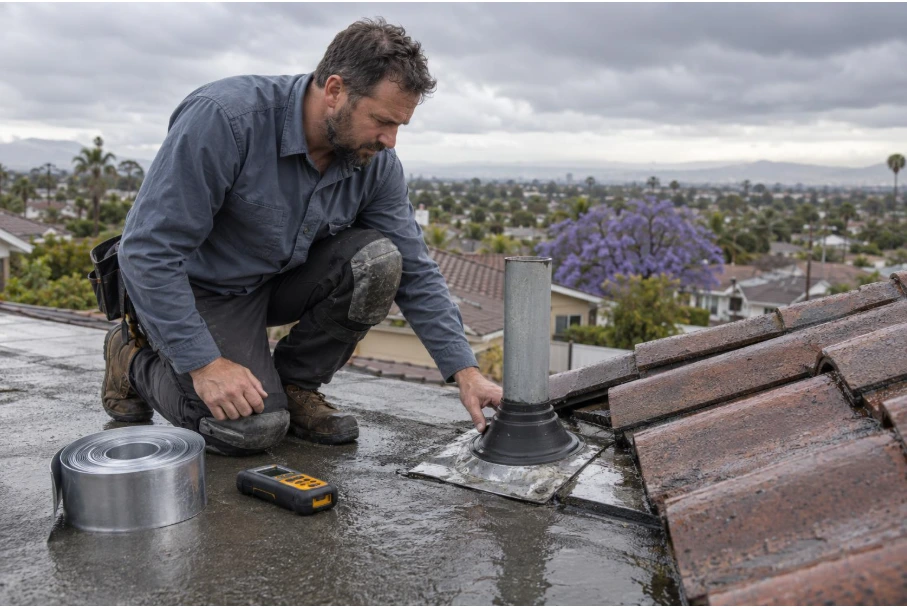
Penetrations are the usual suspects: plumbing vent boots whose rubber collar has split, furnace and water heater flues, old swamp cooler patches, skylight curbs, satellite dish mounts and the tie in where a patio cover or room addition meets the main roof.
Valleys and wall terminations come next. On Eastside ranch homes and the Mesa Verde tracts, low slope additions were frequently tied into a steeper original roof, and that transition is where two different systems have to cooperate. When they stop cooperating, water enters there and shows up somewhere else entirely.
Photograph what you find from the ground with a zoom lens rather than climbing a tile roof. Walking concrete tile without knowing where the battens run is how a small leak becomes several.
When a temporary fix is legitimate and when it is a stall
There is nothing wrong with buying time during a wet week. There is a great deal wrong with buying the same time five years running.
A temporary fix earns its place when it is targeted and documented. A new vent boot slipped under the course above it will hold for years. A properly installed peel and stick patch over a torn section of low slope membrane will get a household through a storm cycle. Fresh sealant on a cracked skylight curb is a real repair when the curb itself is sound.
What does not work is a bucket of roof cement smeared across a general area. It traps moisture, it makes the eventual repair more expensive because it has to be removed, and it hides the evidence a roofer needs to find the entry point. A crew called out for roof repair in Costa Mesa will often spend the first part of a visit scraping off somebody’s emergency mastic just to see the flashing underneath.
If you do apply something yourself, mark the date and location on a note in your phone. That record is genuinely useful six months later.
When the Santa Ana winds have already done the damage
Local leaks are seasonal in a specific way. The winds that run through the basin in autumn lift tile, crack the exposed edges of aging composition shingle and scour granules off south and west facing slopes. Then the first storm arrives and finds every spot the wind opened.
A pre rain walk around in October catches most of it:
- Tiles visibly shifted, lifted at the nose, or cracked across the middle
- Granule accumulation collecting at the bottom of downspouts
- Lifted shingle tabs along ridges and hips
- Dried, cracked sealant at vent collars and flashing edges
- Debris packed into valleys where a roof meets a taller wall
Ridge and hip mortar deserves its own look on older tile roofs. Once that mortar crumbles, the ridge tiles move in wind, and the underlayment beneath them takes rain directly.
When patching has genuinely run out of road
At some point repair stops being the economical answer. The signals are consistent: leaks appearing in three or more unrelated locations, underlayment that crumbles when touched during a repair, widespread granule loss on a composition roof past its third decade, or sheathing that feels soft underfoot across a broad area.
Age alone is not the trigger. A thirty year old tile roof with sound tile and failing underlayment is a lift and relay project, not a replacement, and the tile goes back on. The sensible way to weigh the options is set out in this practical breakdown of whether a roof needs repair, replacement or just an inspection, which is worth reading before accepting any full replacement bid.
Get the diagnosis in writing either way. A report from PWC Roofing or any reputable local firm should name the entry point, describe what was observed rather than assumed, and state whether the repair is expected to be permanent or an interim measure. That distinction is what protects you in a claim and at resale.
Finally, fix the attic side too. A leak that soaked insulation leaves moisture behind, and wet insulation in a closed attic is how a repaired roof still ends up with a mold problem.
Frequently asked
Can a roofer find a leak when it is not raining?
Usually yes, through a combination of attic inspection, moisture readings and controlled water testing of suspected penetrations one at a time.
Does homeowners insurance cover a roof leak?
Sudden storm damage is often covered while gradual wear and deferred maintenance generally is not, which is another reason to keep dated photos and repair records.
How long should a repair last?
A correctly diagnosed and properly flashed repair should last the remaining life of the roof around it, so a repair that fails within a season was a repair aimed at the wrong place.
PWC Roofing
Costa Mesa, CA
Phone: 949-534-6882
Website: pwcroofing.com
