

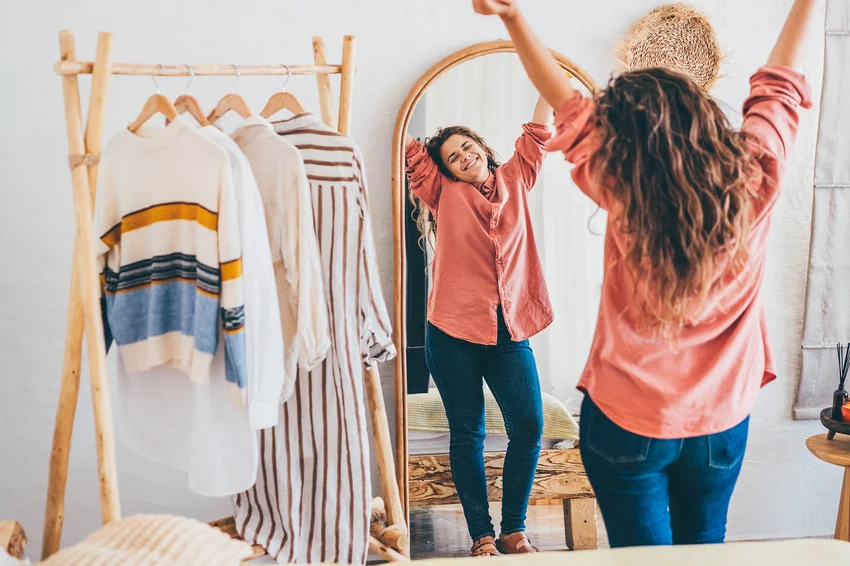
Looking well dressed does not always mean wearing something new, expensive, or complicated.
In fact, some of the outfits that look the most polished are built from pieces most people already own: straight-leg jeans, a plain T-shirt, a button-down shirt, simple trousers, a knit sweater, or a black dress.
The difference usually comes from how those pieces are styled.
Small choices such as proportions, shoes, bags, jewelry, and even how a shirt is tucked can make a basic outfit feel much more intentional. This is useful if you are trying to get more from your wardrobe instead of constantly buying new clothes.
Here are some simple ways to make everyday outfits look more finished without making them feel overdressed.
Start with clothes that actually fit the way you want
Before adding accessories, look at the shape of the outfit itself.
A very simple combination such as jeans and a white T-shirt can work beautifully when the proportions feel right. The same outfit can feel awkward when every piece is either too tight, too oversized, or competing for attention.
You do not need everything to fit close to the body.
Often, the easiest approach is to balance one relaxed piece with something more defined.
If you are wearing wide-leg trousers, try a closer-fitting knit or tucked-in shirt. With slim trousers, an oversized blazer or loose button-down can add some volume.
The goal is not to follow a strict fashion rule. It is simply to make the silhouette look deliberate.
Use one accessory to give the outfit direction
When an outfit feels unfinished, the answer is not always more clothing.
Sometimes it needs one strong accessory.
A shoulder bag can make jeans and a sweater feel more styled. A structured handbag can sharpen a soft outfit. A small evening bag can completely change a simple black dress.
This is also where you can experiment without changing your whole wardrobe.
If most of your clothes are neutral, a bag in burgundy, metallic silver, dark green, denim, or a textured material can become the interesting part of the look.
Sites such as DOKIBAGS are useful examples of how much the mood of an outfit can change simply by switching between structured handbags, softer shoulder bags, compact crossbody styles, and more decorative designs.
The bag does not necessarily need to match your clothes exactly. It simply needs to feel connected to the overall outfit.
Stop trying to match everything perfectly
One of the easiest ways to make an outfit feel more modern is to stop worrying about perfect color matching.
Your shoes do not have to be the exact same color as your handbag.
Your belt does not have to match both of them either.
Instead, think about whether the colors belong to the same general mood.
For example, chocolate brown shoes can work with a black bag. Burgundy can sit comfortably next to gray. Cream can be paired with tan, black, navy, or denim.
Metal hardware does not always need to match perfectly either.
If you are wearing a bag with gold hardware and a small piece of silver jewelry, most people will not notice the difference nearly as much as you think.
A little variation often makes an outfit feel more natural.
Let your shoes set the level of dressiness
Shoes can change the personality of an outfit faster than almost anything else.
Take straight jeans and a simple knit sweater.
With sneakers, the outfit feels casual.
Add loafers and it becomes slightly more polished.
Switch to pointed pumps and suddenly the same jeans can work for dinner.
A block heel makes the outfit feminine without necessarily feeling formal, while boots can add more visual weight during colder months.
This is why it can be more useful to own several different types of shoes than several versions of the same top.
Fashion footwear stores such as ROSATINA show how heel shape, toe shape, straps, texture, and color can change the mood of even a fairly simple outfit.
When deciding which pair to wear, ask yourself what you want the whole outfit to feel like rather than whether the shoe matches one specific item.
Use contrast instead of adding more details
A polished outfit does not need a lot happening at once.
Contrast often does the work for you.
Try a soft knit with structured trousers.
Wear a tailored blazer with relaxed denim.
Pair a feminine midi skirt with a simple T-shirt.
Use a polished handbag with an otherwise casual outfit.
Or wear elegant heels with jeans instead of saving them only for dresses.
These combinations work because the pieces do not all say exactly the same thing.
If every part of an outfit is extremely formal, extremely romantic, or extremely casual, it can start to feel like a costume rather than something you naturally put together.
A little contrast makes it easier to wear.
Pay attention to where clothes end
One styling detail that is easy to overlook is where each piece stops on the body.
Trouser length can completely change how shoes look.
A wide-leg trouser that lightly reaches the top of the shoe creates a different line from one that gathers heavily around the ankle.
Cropped jeans show more of the shoe and can make loafers, flats, or ankle boots more noticeable.
The same applies to jackets.
A cropped jacket changes the proportions of high-waisted trousers, while a longer blazer creates a straighter vertical line.
You do not need to calculate exact measurements. Just look at where the visual lines of the outfit are landing.
Sometimes changing a sleeve roll, trouser cuff, or shirt tuck is enough to make the whole outfit feel better.
Do not save your nicer pieces for special occasions
Many wardrobes contain items that rarely get worn because they have been mentally labeled as “special.”
It might be a small leather bag, a pair of heels, a silk blouse, a tailored coat, or a piece of jewelry.
Try removing that label.
A dressier bag can work with denim.
A satin skirt can be worn with a sweatshirt or knit.
A pair of heels does not always need a cocktail dress.
A blazer can go over a simple tank and jeans.
Wearing nicer pieces in ordinary combinations makes them feel less formal and gives you more outfit options without buying anything new.
It also prevents your favorite pieces from spending most of their lives inside a wardrobe.
Repeat colors instead of matching them exactly
If an outfit feels disconnected, repeating one color somewhere else can quietly pull it together.
This does not mean every item needs an identical shade.
If you are carrying a brown bag, you might repeat brown in a belt, sunglasses, or a small pattern in your top.
If your shoes are burgundy, your lipstick, scarf, or knit could contain a similar deep tone.
Even black works this way.
Black shoes with a light outfit can sometimes feel isolated, but adding a black belt, sunglasses, or bag detail helps make the choice look intentional.
These small repetitions are often more effective than wearing a perfectly matching set.
Know when to stop adding accessories
Accessories help an outfit, but they can also make a simple look feel unnecessarily busy.
If you already have statement earrings, an embellished handbag, detailed heels, a belt, sunglasses, and several necklaces, there may be too many focal points competing with one another.
Choose what you want people to notice first.
If the shoes are dramatic, let them have some space.
If the bag has rhinestones, unusual texture, or noticeable hardware, the rest of the accessories can be quieter.
If the clothing itself has a bold print, you may not need another strong statement.
A polished outfit often feels easy because the eye knows where to look.
Build a few combinations you know always work
Getting dressed becomes much easier when you already know a few outfit formulas that suit your lifestyle.
For example:
- Straight jeans + knit + shoulder bag + loafers
- Wide-leg trousers + fitted top + structured bag + pointed shoes
- Midi skirt + simple T-shirt + crossbody bag + ankle boots
- Black dress + small handbag + heels
- Relaxed jeans + button-down shirt + tote + flats
These are not rules. They are starting points.
Once you know that a certain combination works for you, changing the colors, materials, or accessories gives you many variations without having to create a completely new outfit every morning.
Personal style is often built through repetition
There is a lot of pressure to make every outfit look different, especially online.
Real personal style usually works the opposite way.
People with recognizable style often repeat the same silhouettes, colors, bags, shoes, or combinations because they know what they like.
Maybe you almost always wear neutral clothing but prefer interesting handbags.
Maybe your outfits are simple and your shoes are usually the statement.
Maybe you like oversized tailoring with small structured accessories.
These repeated choices eventually become part of how you dress.
You do not need a wardrobe full of trends to develop personal style. You need enough experimentation to discover which combinations you actually want to wear again.
Final thoughts
Making an outfit look more put together is rarely about adding more.
Often, it means paying closer attention to what is already there.
Check the proportions. Change the shoes. Try a different bag. Roll a sleeve. Tuck the shirt differently. Repeat one color somewhere else in the outfit.
And do not be afraid to mix casual and dressier pieces.
The most useful wardrobe is not necessarily the biggest one. It is the wardrobe where your clothes, shoes, and accessories can be combined in enough different ways that getting dressed still feels interesting.
