

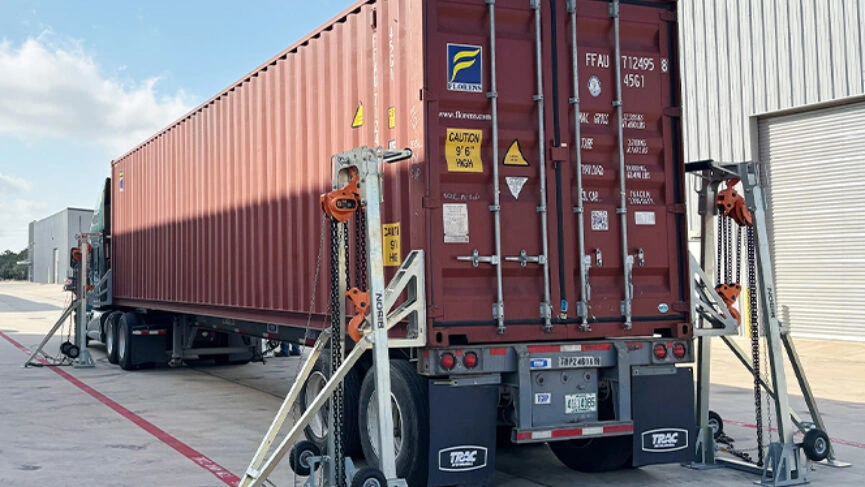
A twenty foot unit needs to shift forty feet across a yard. A crane is a day’s hire with a lift plan, an exclusion zone, and a slot in someone’s schedule. The distance is shorter than the boom.
For moves like that, lifting casters are the alternative: raise the unit off its supports, roll it, set it back down. The mechanics are simple and the failure modes are not, because rolling a load is a different problem from lifting one.
The Rated Capacity Is Per Caster
This is the first arithmetic error and it happens constantly.
A caster rated at 12,000 pounds does not mean four of them handle 48,000. Load does not distribute evenly across four points. Floor irregularities, slight out-of-level in the load, and the sequence in which the casters are engaged all mean one or two carry more than their share.
Standard practice is to size the set so three casters could carry the full load. That sounds conservative until a wheel drops into a floor joint and momentarily transfers its share to its neighbors.
The other half of the arithmetic is the load itself. A container’s gross weight is stamped on it, and that figure includes a payload that may or may not be present. Weighing or calculating the actual load matters, because sizing against the tare when the unit is half full is an error in the wrong direction.
Floors Have Limits Too
The load has to go somewhere, and it goes into the floor through four contact patches.
A polyurethane wheel on concrete contacts across a small area, and the bearing pressure at that point is high. Warehouse slabs are designed for distributed load and for forklift wheel loads, both of which are specified. A heavy caster load sitting stationary on a slab can exceed what that slab was designed to take, particularly near joints or edges.
Asphalt is worse. It deforms under concentrated load, more so in warm weather, and a loaded unit left parked on tarmac leaves four depressions.
Wheel material affects this directly. Harder wheels roll more easily and concentrate load over a smaller area. Softer wheels spread load and absorb surface irregularity at the cost of higher rolling resistance. The choice is a trade between floor protection and push effort, and it should be made against the actual floor rather than by default.
Rolling Introduces Dynamic Load
Static capacity describes a stationary load. Moving changes the numbers.
Striking an obstacle at walking pace produces a shock load considerably higher than the static weight, concentrated at one wheel. Floor joints, expansion gaps, drain covers, and door thresholds all do this. So does the transition from a smooth interior floor to an external apron.
Rated capacities for heavy duty lifting casters typically describe static load with a stated allowance for movement, and that allowance assumes smooth level surfaces. Rough ground eats it quickly.
The practical mitigation is wheel diameter. Larger wheels climb obstacles that stop smaller ones and absorb irregularity more gracefully. They also raise the load higher, which affects stability, so the decision has two sides.
Height Raises The Center Of Gravity
A lifted container is less stable than a supported one, and how much less depends on how high it sits and where its weight is.
An empty container has a low center of gravity. A loaded one may not, particularly if the contents are stacked or the load is uneven front to back. Raising that on casters increases the overturning moment from any lateral force: a push at the wrong height, a gradient, a gust against a large flat side.
The side area of a shipping container is substantial, and wind load against it is not trivial. Moving one outdoors in weather is a decision that needs making deliberately.
Gradient is the other lateral force. A slope that is imperceptible when walking is enough to start a heavy load moving on low-friction wheels, and a load that starts moving on its own is one nobody can stop by hand.
Braking Is Not The Same As Holding
Caster brakes vary considerably in what they actually do.
Wheel brakes stop the wheel rotating. Total-lock brakes stop rotation and swivel. Neither is designed to hold a load on a gradient indefinitely, and neither is a substitute for chocking or for lowering the unit onto proper supports once it is in position.
The failure sequence is predictable: unit moved, brakes applied, crew walks away, load creeps. On a slight slope with four low-resistance wheels, creep is slow and continuous.
Anything left standing on casters needs mechanical restraint independent of the brakes, or it needs to be set down.
Swivel Versus Rigid Determines Control
All-swivel arrangements make a load maneuverable in any direction and give it no directional stability. A heavy unit on four swivel casters will crab sideways under an off-center push and tends to wander.
Two rigid and two swivel gives directional behavior like a trolley: it tracks straight and steers. For long straight moves this is easier to control and considerably safer on any gradient.
The choice depends on the route. A move that requires rotation in a confined space needs swivels. A move down a straight aisle does not, and using swivels for it makes the load harder to keep pointed where it should go.
Lift Height And The Return To Support
Hydraulic casters raise the load enough to clear its supports, and that clearance is finite. A route with a rise in it, a lip, or a ramp may need more than the lift provides.
Surveying the route before the move is the step that gets skipped. Doorway widths, overhead clearance, floor transitions, drain gratings, and the final position all need confirming while there is still time to change the plan.
Setting back down is where corner alignment matters. A container’s load path runs through its bottom corner castings, and it needs to come to rest on supports that engage them. Lowering onto packing that catches the base rail midspan puts concentrated load into a member not designed for it, and the frame deflects.
Four Things To Confirm
The actual weight of the unit, not its rated gross.
The floor’s capacity for concentrated point loads along the whole route, including any transition from interior slab to external surface.
Whether the route has a gradient, and whether the arrangement can be controlled on it.
What the unit is landing on, and whether those supports engage the corner castings.
A crane is expensive and it removes most of these questions. Casters are cheaper and they move the questions onto the crew doing the move.
