

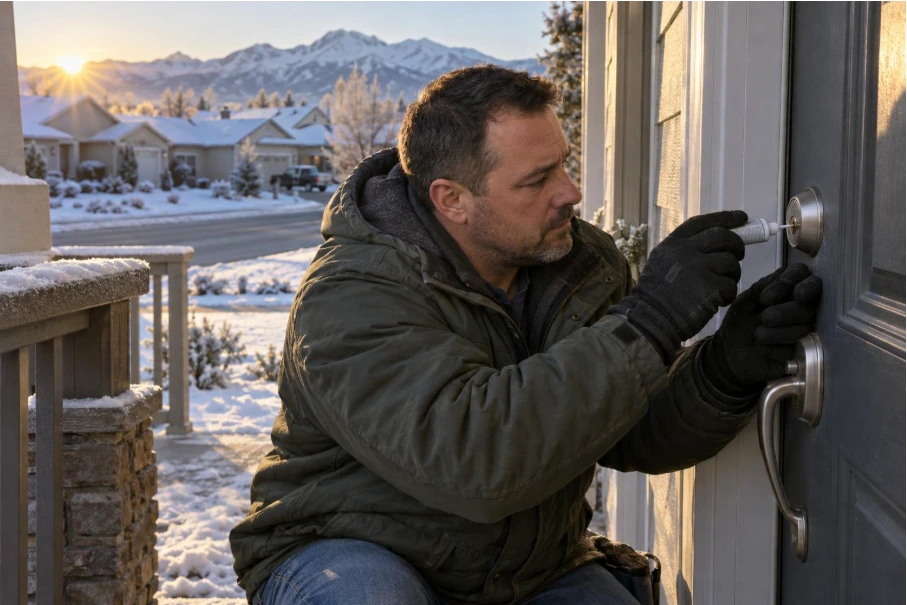
The first hard freeze in Sparks arrives with a particular kind of phone call. A deadbolt that turned smoothly all autumn will not budge at seven in the morning. A car fob that worked yesterday is dead in the driveway with the temperature in the teens. A garage side door has swollen shut, and a sliding door has frozen in its track. None of these is a failure of the lock. They are what metal, batteries and moisture do when the Truckee Meadows drop below freezing and stay there.
Winter lock problems are predictable, which means they are preventable, and the fixes are small if they happen in November rather than in a snowstorm.
Frozen deadbolts and the moisture inside them
A lock cylinder freezes when water gets into it and turns to ice around the pins. The water arrives as rain or melting snow driven into the keyway, or as condensation on a cold night, and a lock that was sprayed with an oily lubricant holds that water against the pins. The fix on the morning it happens is gentle: a lock de-icer, or warming the key in your hand and working it slowly, never forcing it, since a key snapped in a frozen cylinder is a bigger problem than a frozen cylinder.
The prevention is a dry lubricant, graphite or a PTFE product, applied before the season, and a keyway that is shielded from direct weather where possible. A Sparks locksmith can service every exterior cylinder in one visit, clearing old gummed lubricant and leaving a dry film that sheds moisture instead of trapping it.
Doors that swell, bolts that miss
Cold, wet weather swells wooden doors and frames, and a deadbolt that seated cleanly in September can stop short of the strike in January. The symptom is a key that turns only when you push or pull the door, and the risk is a household that gives up and leaves the door unlocked. The fix is an adjustment of the strike plate or a slight easing of the door, done once for the season, and it is the kind of small job that prevents the larger one.
Fobs and batteries in the cold
Coin-cell batteries lose capacity as temperatures drop, and a fob that was marginal in October goes silent on a cold morning. Replace fob batteries in late fall as a habit, carry the spare key for vehicles that have one, and know where the hidden mechanical key sits inside a push-to-start fob. A fob left in a car overnight at fifteen degrees is the most common reason for the dead-fob call, and the second most common is a battery that was already weak.
The winter checklist for a Sparks home
- Dry-lubricate every exterior lock cylinder, including the garage side door and the shed
- Have strike plates adjusted so every deadbolt throws fully without pushing on the door
- Replace fob and keypad batteries, and keep a mechanical key for every electronic lock
- Clear snow and ice from the sliding door track and the threshold before forcing anything
- Keep a lock de-icer in the house and one in the car, not only in the frozen vehicle
- Check that the garage door’s bottom seal is not freezing to the slab
Snow season and security
Winter changes how a house is watched. Shorter days mean more hours of darkness, snow shows footprints to the back door, and holiday travel leaves homes empty. Motion lighting at the side and rear, a keypad deadbolt so a neighbor can check the pipes without a loose spare key, and a rekey if any key went missing during the year are the three changes that matter most before December.
Vehicles have their own winter cost. Lost or broken keys rise in the cold as gloves, deep pockets and frozen locks take their toll, and the realistic numbers are laid out in this guide to what a replacement car key really costs around Sparks and Reno.
Booking the work before the storm
The visit that prevents winter lock calls is a short one: cylinders cleaned and dry-lubricated, strikes adjusted, keypads tested, batteries swapped. Companies such as Nevada Lock & Key schedule these across Sparks and Reno in the weeks before the first snow, and the households that book them are the ones whose deadbolt still turns on the coldest morning of the year.
Quick answers
Can I use hot water on a frozen lock?
No; it refreezes inside the cylinder and makes the next morning worse. Use a de-icer or warm the key.
Why does my key work in the afternoon but not in the morning?
Ice in the cylinder or a swollen door; both are fixed with a service visit, not a new lock.
Should I switch to a smart lock for winter?
Only one rated for low temperatures, with lithium batteries and a mechanical override; otherwise the cold creates a new failure point.
Nevada Lock & Key
Sparks, NV
Phone: 775-252-8899
Website: nevadalockandkeyllc.com
