

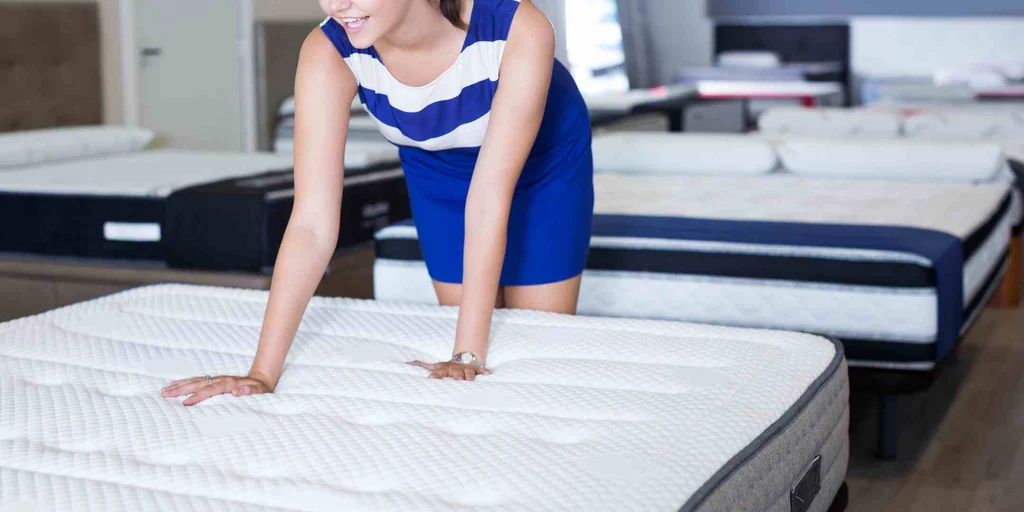
A mattress develops a soft depression along one side within eighteen months. The owner concludes the mattress failed early and the sleep surface degraded faster than it should have.
The frame underneath has slats spaced seven inches apart and no center support. The mattress is doing what any mattress does when the surface beneath it flexes: settling into the gaps.
What a mattress rests on affects how it performs and how long it lasts, and the two components are almost always chosen separately, at different times, from different considerations.
The Base Is Part of the Sleep System
A mattress is not a self-supporting structure. It relies on a flat, continuous, load-bearing surface beneath it.
Where that surface is inadequate, the mattress conforms to it. Gaps between slats allow the material to sag into them. A frame that flexes under load transfers that flex into the sleep surface.
The effect concentrates where load is greatest, which is the center of the bed under the hips and shoulders. That is also where sagging is most noticeable and most consequential for spinal alignment.
Manufacturers specify support requirements for this reason, and warranty terms commonly reference them.
Slat Spacing Has a Working Limit
Slatted frames vary widely in construction, and spacing is the parameter that matters most.
Wide gaps allow the mattress to deflect between slats. Foam and latex constructions, which are continuous materials, sag into gaps readily. Pocketed spring units resist somewhat better, since individual springs bridge short distances, but the effect still appears over time.
Most mattress warranties specify a maximum spacing, commonly in the range of two to three inches for foam and latex. Frames sold as suitable for any mattress frequently exceed it.
Slat thickness and material matter alongside spacing. Thin slats flex under load even when closely spaced, and flexible slats deflect more at the center of their span than at the ends.
Center Support Carries the Highest Load
A frame wider than a twin needs support along its centerline.
Without it, the side rails carry the entire load across an unsupported span, and the span is longest exactly where the load is greatest.
Center rails with legs to the floor transfer that load directly rather than through the frame’s joinery. Queen and king frames typically require one center rail with at least one leg; larger sizes require more.
Frames sold without center support for these sizes are common, and the deficiency shows in the mattress rather than in the frame, which is why it is often misdiagnosed.
Platform Beds and Box Springs Serve Different Constructions
The two base types are not interchangeable, and the mattress determines which applies.
A platform base provides a solid or closely slatted surface directly under the mattress. Foam, latex, and most hybrid constructions are designed for this.
A box spring, properly a foundation, contains springs or a rigid grid and was designed to work with traditional innerspring mattresses, contributing to the overall response of the system.
Placing a foam mattress on a sprung foundation introduces flex the mattress was not designed to accommodate. Placing an innerspring mattress designed for a foundation on a rigid platform changes its feel and can shorten its life.
Retailers carrying Portland, Maine mattress stock generally match base to construction at the point of sale, since the pairing affects both the initial feel and the warranty position.
Bed Frame Height Affects Daily Use
Total height is the sum of frame, foundation if present, and mattress depth, and it is easy to get wrong.
A comfortable seated height puts the top of the mattress roughly level with the back of the knee when sitting on the edge with feet flat. Too high or too low makes getting in and out awkward, and the effect compounds with age or limited mobility.
Mattress depth varies considerably between models, so a frame that worked with one mattress may sit too high or too low with its replacement.
Bedding fits by mattress depth. Deep mattresses require deep-pocket sheets, and standard-depth sheets will not stay on.
Ventilation Beneath the Mattress Matters
Body moisture passes into the mattress during sleep and has to leave it.
A base allowing airflow underneath lets that moisture dissipate. A fully solid base on a solid floor restricts it, and moisture accumulates at the underside.
The consequence in humid conditions is mildew on the mattress underside, which is not always noticed until the mattress is turned.
Slatted bases inherently ventilate. Solid platforms benefit from ventilation holes, and mattresses on solid bases should be lifted periodically to allow the underside to dry.
Placing a mattress directly on a floor, particularly a concrete or ground-floor surface, restricts ventilation entirely and adds the risk of moisture from below.
Rotation and Flipping Depend on Construction
Maintenance requirements vary with how the mattress is built.
Single-sided constructions, which have a specific comfort layer on top, are rotated head to foot but never flipped. Rotating redistributes wear across the surface.
Double-sided constructions can be flipped as well as rotated, which doubles the surface available and extends useful life.
The interval is typically every few months, more frequently in the first year while materials settle.
Neither rotation nor flipping corrects damage from inadequate support. Where the base is the problem, the depression reappears in the same place.
Warranty Terms Reference the Base
Mattress warranties commonly include support requirements as a condition of coverage.
Terms specify slat spacing limits, center support requirements by size, and in some cases the base type. A claim for sagging on a non-compliant base is often declined.
The measurement threshold for a valid sagging claim is usually stated as a depth measured with the mattress unloaded, and depressions shallower than that figure fall outside coverage regardless of base.
Retaining the base documentation alongside the mattress paperwork puts the compliance question beyond dispute if a claim arises.
What the Purchase Should Cover
The relevant checks span both items rather than the mattress alone.
The mattress construction type, and the base type it specifies. Slat spacing on the intended frame, measured rather than assumed. Center support present, with legs to the floor, for queen and larger. Combined height against comfortable seated height. Ventilation under the mattress. Rotation requirements, and whether the construction permits flipping.
A well-made mattress on an inadequate base underperforms and wears early. The base costs a fraction of the mattress and determines much of what the mattress delivers.
