

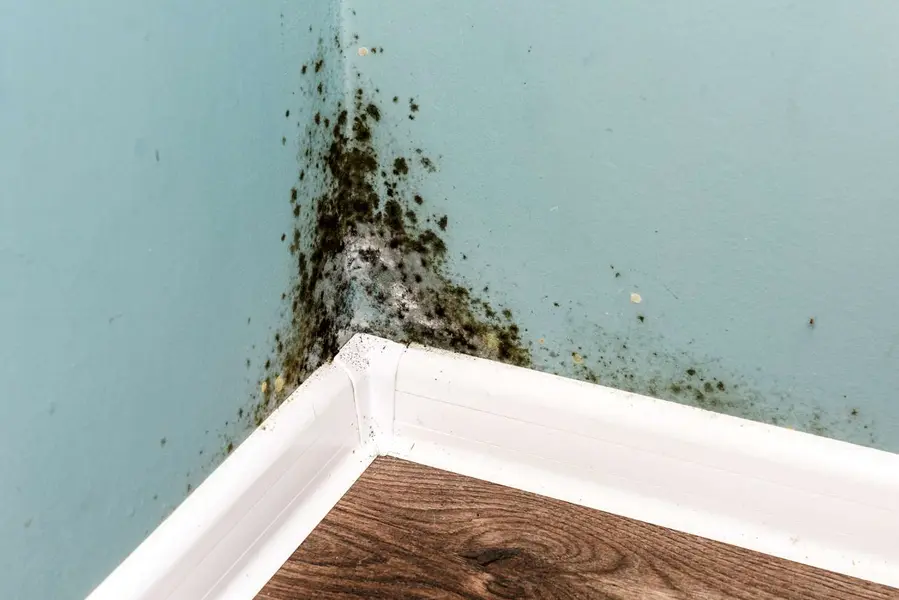
The dark patch on a wall is a symptom. The problem sits behind it.
A leaking flange, a cold corner, a clogged dryer vent, a slab that wicks groundwater six inches up the gypsum. These are the sources. The stain is the signal.
Drywall is a paper-faced, cellulose-rich building material. Black mold feeds on cellulose, and Stachybotrys chartarum is the species most often isolated from lab samples of stained gypsum walls. Each wet-and-dry cycle can introduce spores into the room and degrade indoor air quality.
Before you reach for cleaning supplies, get one thing clear.
If you treat the stain without addressing the source of moisture, it will return.
In this guide, you will learn how to read the pattern so you can:
- Spot the likely moisture source fast.
- Know when a patch job makes sense, and when removal does.
- Talk to a mold remediation professional with useful details.
For homeowners dealing with black mold on drywall, this diagnostic step matters more than any product.
What follows is a field guide to six common patterns and the building failures that give rise to them.
1. The Halo Around a Nail
A dark ring around a single fastener points to thermal bridging. The steel or coated nail conducts cold from the exterior cavity into a warm interior surface, the dew point hits at that pinprick, and condensation forms on the paper face, where black mold on drywall takes hold within days.
Halos cluster around exterior walls in cold climates and around ceiling fasteners under attics with thin insulation. Cleaning the spot accomplishes nothing. The fix is insulation correction, vapor management, or both, after which the wallboard can be patched and recoated.
2. The Bottom-Edge Bloom
A horizontal band of black-and-green growth running along the base of the drywall, two to eight inches above the floor, is one of the clearest indicators of water damage in residential construction and a textbook signature of capillary uptake. Concrete slabs and below-grade walls hold ground moisture. Drywall set tight against either acts like a paper towel dipped in water.
Corroborating clues to look for:
- Efflorescence on adjacent concrete.
- Soft baseboard wood.
- A musty smell at floor level.
- Cupped or stained flooring near the wall.
The repair sequence is brutal and simple. Cut the affected wallboard a foot above the bloom line, install a capillary break, dry the cavity, then rebuild with mold-resistant board and a small gap above the floor.
3. The Ceiling Fan-Out
A soft-edged, dark, oval mark above a tub, shower, or kitchen range indicates the source is condensation. The room generates humid air, the ceiling sits below the dew point, and water lingers on the drywall surface long enough for spores to germinate. Roof leaks produce hard edges and brown tannin staining, so the geometry alone separates the two diagnoses.
Bath fans rated under 80 CFM, missing duct insulation, and short run times after showers are the common culprits.
Repeated exposure to black mold on drywall during shower hours can irritate the respiratory systems of even healthy adults.
A fan upgrade, a humidistat, and an insulated duct that terminates outside the envelope (at the soffit or a roof cap) will silence the problem.
4. The Drip Trail
Vertical streaks descending from a corner, a window head, or a fixture penetration tell a plumbing story. Water flows down through the cavity, contacts the back of the drywall, and feeds colonies that grow tall and narrow. The trail can travel six feet from its origin before showing up on the painted face.
Common origin points include:
- Failed wax rings on second-story toilets.
- Shower pan and curb leaks behind tile.
- Window flashing that pushes water inward.
- Ice dams in northern climates.
- Condensate lines from HVAC units in the ceiling cavity.
A pin meter, an infrared scan, and a hard look at the floor above will trace the trail back to its source. For any affected area larger than 10 square feet, call in a certified water damage restoration company before the colony reaches the framing. Replace the failed component, dry the cavity for three to five days, then schedule wallboard repair.
5. The Spotted Field
Hundreds of tiny black dots scattered across a closet wall, a basement room, or the surface behind a sofa pushed against an exterior wall point to ambient humidity above 60 percent for a sustained period. The colonies stay small because no single point delivers water; the whole room delivers it through stagnant, damp air.
Dehumidification is the cure. Sensors placed at floor level reveal the true conditions, and a dehumidifier sized to the space, set to a humidistat, will pull the air back below 50 percent.
Wallboard with light surface mold issues and intact paper can sometimes be cleaned and coated with an antimicrobial sealer. Anything bubbled, warped, or soft must come out.
Black mold on drywall follows a hierarchy of severity. Patches larger than two square feet require cutting back to the dry framing, and any plan to remove black mold on drywall without addressing the source guarantees a return visit.
6. The Geometric Ghost
A clean rectangle of mold growth on a drywall surface, often behind a flat-screen TV, a bookshelf, or a framed mirror, is a sign of air-circulation starvation. Objects pressed flush against a cool exterior wall trap a thin layer of stagnant air. That microclimate sits warmer and wetter than the rest of the room, where black mold on wood framing develops in step with the bloom on the gypsum face.
A surface problem on the painted side runs deeper than the paint.
Shape gives the diagnosis: growth ends where the object began. Pull the object an inch off the wall, restore air flow, and the colony seldom returns after remediation.
What This Means for Repair
Wallboard contractors and water-restoration crews tend to split the world into two camps. Wipe the surface and move on, or rip out every wall within a five-foot radius. Both approaches skip the diagnostic step.
A patch laid over wet drywall traps moisture against the new board and accelerates the growth of black mold on drywall.
A homeowner who learns to read the pattern can brief a mold remediation professional, an air-quality specialist, or a drywall contractor with specifics that save them an hour of guesswork. The same brief saves the household thousands in unwarranted demolition and keeps the colony from showing up six months later on the next wall over.
Removing black mold drywall colonies the right way means coordinating mold removal services with the trade that repaired the source of moisture. A mold remediation specialist who documents pre- and post-treatment moisture readings earns a callback. Professional mold remediation that ignores the source loses it.
Three questions belong on every assessment before a single piece of board comes down:
- What is the growth pattern, and what does it suggest about the moisture source?
- Has the source been confirmed with a meter reading, a visual cavity inspection, or a flow test?
- What environmental control, such as insulation, ventilation, dehumidification, or plumbing repair, will keep it from coming back?
Skip any one of the three, and demolition turns into guesswork, with the same mold returning within twelve months.
Looking Down the Road
Building science is reshaping residential repair fast. Tools that were once niche are now routine. Infrared cameras cost less than a mid-range toolbox. Pinless moisture meters fit in a pocket. Smart dew-point loggers send real-time readings to a phone.
Soon, drywall pros will diagnose what is happening inside the wall as part of the job, not as an extra step. They will hang, finish, and interpret what the wall is telling them.
Air-quality specialists, drywall contractors, and mold removal crews will work from the same measurements, so the site plan stays aligned.
A mold stain in 2026 should start a systems-level diagnosis of the home. Paint covers a mark. It does not solve the conditions that created it. The wall will keep giving signals, and the right trade will know how to read them.
